Part 2 of my video for costumers and cosplayers is up! I include sewing advice and general tips for wearing your costume well. Have a great weekend and thanks for all your support on the newly revamped channel!

Showing posts with label accessories. Show all posts
Showing posts with label accessories. Show all posts
Thursday, August 6, 2015

Friday, March 16, 2012
Obi-dome Tutorial: Kimono Jewelry
Traditionally, kimono are worn with no jewelry whatsoever: no earrings, necklaces, bracelets, rings, etc., though it is worth nothing that in modern times those rules are loosening up, especially in casual situations.
One of the only ornaments seen with kimono is the "obi-dome" 帯留め/帯留(oh-bee doh-meh), a sort of brooch or bead threaded through the obi-jime cord worn over the obi.

Obi-dome are a kind of novelty item and are usually worn with casual kimono up through mid-formal ones, depending on the flashiness or use of jewels. Two of the most notable exceptions to this rule are large, playful ones sometimes seen with young women's furisode and huge, high-end ones worn by maiko (apprentice geisha).


Here are some examples from the Rakuten seller "Sou-bien", ranging from cute to chic.


Obi-dome are a bit whimsical by nature, as you can tell by the photos above, so pretty much anything goes. :) If you'd like to make your own, here's a quick tutorial I put together.
One of the only ornaments seen with kimono is the "obi-dome" 帯留め/帯留(oh-bee doh-meh), a sort of brooch or bead threaded through the obi-jime cord worn over the obi.

Obi-dome are a kind of novelty item and are usually worn with casual kimono up through mid-formal ones, depending on the flashiness or use of jewels. Two of the most notable exceptions to this rule are large, playful ones sometimes seen with young women's furisode and huge, high-end ones worn by maiko (apprentice geisha).


 |
| Bottom photo: Maiko Humihana 富美英、Fumisono 富美苑、 Fumitama 富美珠 photo credit Onihide |
Here are some examples from the Rakuten seller "Sou-bien", ranging from cute to chic.


Obi-dome are a bit whimsical by nature, as you can tell by the photos above, so pretty much anything goes. :) If you'd like to make your own, here's a quick tutorial I put together.
 |
| Click to see full-size. |
Monday, November 8, 2010
Costuming: Wig Tips
If you're into cosplay or costuming and like taking it to a truly detailed level, authentic human hair Japanese wigs really perfect the whole look when it comes to traditional Japanese costumes. You can actually find them on Ebay, under "katsura", though be warned that most will technically be wedding or generic wigs rather than the higher-end ones for geisha or maiko.
However, as most Westerners don't know the difference, I don't see a problem in wearing a generic/wedding one as long as you don't claim it's a super-authentic geisha wig you yanked off a real geisha's head while on your trip to Japan. ^_^; (While maiko wigs are more distinctive, geisha ones are very similar to wedding ones in appearance.)
Should you get your hands on one of these babies, here are some tips or things you might not have known beforehand, based on my own wig purchase:
1. They are styled with camellia oil, I believe, so they have a distinct scent that I don't mind but can be a bit strong at times.
2. The wigs have a hard base, so you're more or less wearing a football helmet. I've made it eight hours in mine with some discomfort that I was able to alleviate by minutely shifting it every few hours, but I've heard the average runs more to 3-4 hours for comfortable wear.
3. For my American readers, Sally's Beauty Supply has $4 styrafoam heads, in case your wig didn't come with the traditional stand and case.
4. The wig adds a lot of mass all around your head, so if you can leave it off if you have to take any tight car rides, etc. to your destination.
However, as most Westerners don't know the difference, I don't see a problem in wearing a generic/wedding one as long as you don't claim it's a super-authentic geisha wig you yanked off a real geisha's head while on your trip to Japan. ^_^; (While maiko wigs are more distinctive, geisha ones are very similar to wedding ones in appearance.)
Should you get your hands on one of these babies, here are some tips or things you might not have known beforehand, based on my own wig purchase:
1. They are styled with camellia oil, I believe, so they have a distinct scent that I don't mind but can be a bit strong at times.
2. The wigs have a hard base, so you're more or less wearing a football helmet. I've made it eight hours in mine with some discomfort that I was able to alleviate by minutely shifting it every few hours, but I've heard the average runs more to 3-4 hours for comfortable wear.
3. For my American readers, Sally's Beauty Supply has $4 styrafoam heads, in case your wig didn't come with the traditional stand and case.
4. The wig adds a lot of mass all around your head, so if you can leave it off if you have to take any tight car rides, etc. to your destination.
Saturday, September 18, 2010
Yamatoku Classic: Wigs and Hair Ornaments
Kimono dealer Yamatoku Classic has a new "kimono goods festival" sale up, with some good prices (5 pack of obi-age scarves for $30, 10 pack of obi-jime cords for $40) and items they don't usually list, like wigs, shigoki obi and hair ornament sets.
The usual Yamatoku advice applies: ignore the word "geisha" in the titles as very little if any of it is actually geisha-related (trying to pump up their keyword search returns, I guess?). Enjoy the beautiful items for what they are (the hair ornaments are, I believe, mostly if not all for weddings, as an example) but if you're after items that are specifically geisha-related, I'd pass.
The usual Yamatoku advice applies: ignore the word "geisha" in the titles as very little if any of it is actually geisha-related (trying to pump up their keyword search returns, I guess?). Enjoy the beautiful items for what they are (the hair ornaments are, I believe, mostly if not all for weddings, as an example) but if you're after items that are specifically geisha-related, I'd pass.
Tuesday, September 7, 2010
What Do You Call... Those Drawstring Bag Purses?
Today's entry is about the small little purses you'll sometimes see people carrying with casual kimono like summer yukata. Sometimes seen with a square or circular woven basket bottom, the top of the bag is cloth closed with drawstrings and is worn held at the side or dangling from the wrist.

These little purses are called "kinchaku" (keen chah koo) 巾着. As these are traditional bags, you'll sometimes see geisha and their apprentices maiko carrying larger versions of kinchaku as part of their normal wardrobe.


Girl wearing yukata in Kyoto, with kinchaku at her side. Image courtesy Paul Vlaar, from Wikimedia.
These little purses are called "kinchaku" (keen chah koo) 巾着. As these are traditional bags, you'll sometimes see geisha and their apprentices maiko carrying larger versions of kinchaku as part of their normal wardrobe.

Geiko (Kyoto geisha) Kimika, carrying the large style held in one's arms. Image courtesy Onihide and used with permission.
Friday, July 23, 2010
Ryu Japan Update - $6 Geta Sale
Ryu has put up 78 pairs of women's geta (wooden clogs worn mainly for summer yukata) for a sale price of $6. Double-check your size with a conversion chart before ordering, however: While it is normal for a little bit of the heel to hang off the back of geta and their more formal cousins zori, if it's more than .5 cm away from your normal shoe size you might find the fit too tight to wear.
Tuesday, July 13, 2010
Tsumami Kanzashi Photo Gallery
All credit for this find goes to Immortal Geisha forum member shigatsuhana (thank you!), who first posted a link there to this short article and beautiful photo gallery of traditional folded-silk hair ornaments (tsumami kanzashi).
Among the little pieces of art, made by third-generation craftsman Tsuyoshi Ishida, you'll find everything from classical cranes and maple leaves to whimsical shrimp and watermelons.
Among the little pieces of art, made by third-generation craftsman Tsuyoshi Ishida, you'll find everything from classical cranes and maple leaves to whimsical shrimp and watermelons.
Wednesday, July 7, 2010
Ichiroya Update: Summer Obi-age
If you look a couple of posts down, you'll see the otaiko style of tying an obi. That big poofy box in the back is created using a couple of tricks, one of which is the obi-age.
The obi-age is a scarf that goes over a small pillow (obi makura) tied under the poof in the back to hold it up. You put the middle of the obi-age across the pillow, bring both ends around to the front, along the top of the obi, tie them, and tuck the ends and the rest of it in along the top. It's support plus a bit of color in an outfit.
For the hottest months of the year, cooler "summer" items can be worn, and Ichiroya's update today has a few summer-weight obi-age in new condition.
The obi-age is a scarf that goes over a small pillow (obi makura) tied under the poof in the back to hold it up. You put the middle of the obi-age across the pillow, bring both ends around to the front, along the top of the obi, tie them, and tuck the ends and the rest of it in along the top. It's support plus a bit of color in an outfit.
For the hottest months of the year, cooler "summer" items can be worn, and Ichiroya's update today has a few summer-weight obi-age in new condition.
Thursday, June 24, 2010
What Do You Call...? - Sandal Straps
Tonight's entry is short and sweet:


When you look at either geta or zori sandals (the first is casual, the second more formal), they always have V-shaped straps, and these straps are called hanao 花緒.


Examples of geta and zori. Images copyright Ichiroya and used with permission.
Tuesday, June 22, 2010
Fans: Uchiwa vs. Sensu
You may have already seen the two main types of fans in Japan, but do you know their names?

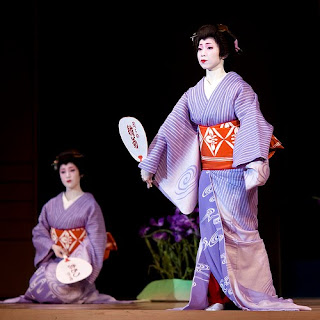
Sensu 扇子 are folding fans, and uchiwa 団扇 are the flat, round fans you see used in the summer, though sensu are also used during the summer as well. Both can be found in department stores, and you can even get cheapies in convenience stores.
In pop culture, the "Uchiha" clan and symbol in Naruto is a play on that, and during the hottest months businesses will sometimes hand out cheap uchiwa with their company logo at festivals or near train stations.
In pop culture, the "Uchiha" clan and symbol in Naruto is a play on that, and during the hottest months businesses will sometimes hand out cheap uchiwa with their company logo at festivals or near train stations.

An uchiwa, courtesy Wikimedia.

"17th Miyako no Nigiwai" (Performance): Scene 2 Nagauta Ayameyukata 長唄 菖蒲浴衣
Geiko Tsunemomo and Hinagiku from Gionhigashi, photo by Onihide.
Geiko Tsunemomo and Hinagiku from Gionhigashi, photo by Onihide.
Dancers use larger versions of sensu, sometimes painted with gold and silver, but these are never used while fanning yourself at a festival or standing on the train platform, like normal sensu.


"17th Miyako no Nigiwai": Scene 3 Nagauta Kishi no Yanagi
Geiko Naosome and Umeha from Kamishichiken, photo by Onihide.
Thursday, May 27, 2010
What Do You Call...? - Obi Cord Jewelry
If you look at enough pictures of women in kimono you'll start noticing that occasionally they'll have a bead or ornament of some kind on the cord tied around the middle of the obi.
This is called an "obi-dome" 帯留 and isn't usually worn with a summer yukata, though I believe you can find it on just about every other level of kimono formality. They can be very traditional or cute and funky (Mamechiyo Modern has acorns, flowers and a spaceship one), the size ranging from small to fairly big.
Coincidentally enough, while looking through Onihide's photostream for images, as he's given me permission to use his (thank you again! :) ), I ran across a perfect example with the obidome highlighted on a full kimono outfit: mouse over this photo to see a box appear around the maiko's obidome.
This is called an "obi-dome" 帯留 and isn't usually worn with a summer yukata, though I believe you can find it on just about every other level of kimono formality. They can be very traditional or cute and funky (Mamechiyo Modern has acorns, flowers and a spaceship one), the size ranging from small to fairly big.
Coincidentally enough, while looking through Onihide's photostream for images, as he's given me permission to use his (thank you again! :) ), I ran across a perfect example with the obidome highlighted on a full kimono outfit: mouse over this photo to see a box appear around the maiko's obidome.
Sunday, May 16, 2010
Ichiroya Update - 25cm Zori!
When was the last time you saw a flying piggy or Satan on ice skates, or Satan figure skating with a flying piggy? That's about how often you see affordable women's zori sandals above 24cm (roughly American women's 8), and Ichiroya has just put up ten 25cm pairs (roughly American women's 9) for only $48. Usually when you do see these, at least in my experience, they're $75-$100.
Hence the exclamation mark in the title. Enjoy your Sunday. :)
Hence the exclamation mark in the title. Enjoy your Sunday. :)
Friday, May 14, 2010
What Do You Call...? - Hair Ornaments
While chopsticks are never worn in the hair in Japan, a great many beautiful hair ornaments can be worn with kimono. What are they called?

In general, they're called "kanzashi" 簪 and today the nicest ones are most often worn by geisha and oiran-actors (oiran were courtesan prostitutes and were outlawed a long time ago, so today you only see re-enactors).
If you're looking for the ones maiko, apprentice geisha, wear with dangling bits of silver that look almost like wind chimes, you want "bira bira" (sparkle sparkle) kanzashi. びらびら簪
The pretty tortoiseshell (or look alike) combs are called kushi 櫛 and are usually paired with thick hair sticks called kogai 笄, as seen in the photo above, and the ones with flowers made of folded squares of silk are called "tsumami" kanzashi つまみ簪.


In general, they're called "kanzashi" 簪 and today the nicest ones are most often worn by geisha and oiran-actors (oiran were courtesan prostitutes and were outlawed a long time ago, so today you only see re-enactors).
If you're looking for the ones maiko, apprentice geisha, wear with dangling bits of silver that look almost like wind chimes, you want "bira bira" (sparkle sparkle) kanzashi. びらびら簪
The pretty tortoiseshell (or look alike) combs are called kushi 櫛 and are usually paired with thick hair sticks called kogai 笄, as seen in the photo above, and the ones with flowers made of folded squares of silk are called "tsumami" kanzashi つまみ簪.

Pimpin' it really old school: a classical oiran, the biggest and boldest wearers of kanzashi in Japanese history. Photo by Gene Jackson.

An example of the waterfall-like "hana (flower) kanzashi 花簪" style worn by maiko, showing the tsumami folding technique. Photo by Pitke.
Sunday, April 11, 2010
Tips for Kimono Newbies: What is a Haori?
Inspired by questions I got at the kimono booth this weekend (I'm tired, but again it was another fun, busy day: thank you to everyone who stopped by!), our topic for tonight is haori.
What is a haori? A haori is a jacket worn over kimono. It is never meant to be worn as a top by itself, or crossed over in the front like a kimono. The collar is meant to hang straight down along your chest.
There are both men's and women's haori, and you can check which gender one is meant for just like kimono: look at the back of the sleeves. Women's will be open, where you could stick your hand in, and men's will be closed and/or sewn to the body of the haori itself. Below are two women's, followed by a man's.


I like wearing mine with Western clothes, as it's easier to work a jacket into your look rather than an all-out kimono ensemble: a black silk haori with subtle patterns can look really nice with a pair of dark jeans, dark top and heels, or worn with a nice dress for a night out at the symphony, etc.
Images copyright Ichiroya and used with permission.
What is a haori? A haori is a jacket worn over kimono. It is never meant to be worn as a top by itself, or crossed over in the front like a kimono. The collar is meant to hang straight down along your chest.
There are both men's and women's haori, and you can check which gender one is meant for just like kimono: look at the back of the sleeves. Women's will be open, where you could stick your hand in, and men's will be closed and/or sewn to the body of the haori itself. Below are two women's, followed by a man's.


I like wearing mine with Western clothes, as it's easier to work a jacket into your look rather than an all-out kimono ensemble: a black silk haori with subtle patterns can look really nice with a pair of dark jeans, dark top and heels, or worn with a nice dress for a night out at the symphony, etc.
Images copyright Ichiroya and used with permission.
Wednesday, March 24, 2010
How Much? Yukata
If you're thinking about putting together a kimono look, to wear normally or for a cosplay or costume, you might be wondering how much you're probably going to spend. I've seen hideously overpriced items in my time collecting, and ones that are real steals. Another ongoing series, "How Much?" will give you my highly subjective, personal experiences in Kimono Price Land on what is a good price, what you should snap up immediately and what you should pass on with raised eyebrows. ;)
Before I get started, and I'll repeat this in every entry for this series, it's not impossible to occasionally see a really high-priced item, due to age or rarity, etc. However, most of the time in my opinion you're more likely to see prices in this range. I pull my estimates from a long time spent on Ebay, online with various dealers, and a bit of convention-going thrown in.
The lowest price is the lowest price I've ever seen, and the highest I consider reasonable, give or take a few bucks, with both prices including shipping if you see this on an online site. Usually most pricing will fall around the middle.
Yukata Look (Casual cotton summer outfit)
What You Need (the absolute basics):
1. yukata kimono: ~$20-$100, the $100 for excellent-condition unused ones, as new ones can at times sell for $150-ish in Japan)
2. simple (one color, synthetic) hanhaba obi: ~$20-$60
Don't Forget!
-Sports bra
-Kimono underwear or a white tanktop and white skirt or leggings/shorts
-2 koshihimo or long cords or strips of fabric to tie the kimono shut and set the hem and collar
-1 obi ita board or stiff piece of posterboard to keep the obi flat in front
-cute footwear (geta ideally, but I've seen cute low heels and sandals worn by Japanese girls)
Before I get started, and I'll repeat this in every entry for this series, it's not impossible to occasionally see a really high-priced item, due to age or rarity, etc. However, most of the time in my opinion you're more likely to see prices in this range. I pull my estimates from a long time spent on Ebay, online with various dealers, and a bit of convention-going thrown in.
The lowest price is the lowest price I've ever seen, and the highest I consider reasonable, give or take a few bucks, with both prices including shipping if you see this on an online site. Usually most pricing will fall around the middle.
Yukata Look (Casual cotton summer outfit)
What You Need (the absolute basics):
1. yukata kimono: ~$20-$100, the $100 for excellent-condition unused ones, as new ones can at times sell for $150-ish in Japan)
2. simple (one color, synthetic) hanhaba obi: ~$20-$60
Don't Forget!
-Sports bra
-Kimono underwear or a white tanktop and white skirt or leggings/shorts
-2 koshihimo or long cords or strips of fabric to tie the kimono shut and set the hem and collar
-1 obi ita board or stiff piece of posterboard to keep the obi flat in front
-cute footwear (geta ideally, but I've seen cute low heels and sandals worn by Japanese girls)
Saturday, March 6, 2010
Kimono Kanji Cheat Sheet
Beyond the satisfaction of learning new words in a language, if you're interested in kimono, knowing the original Japanese names can help you in searching online for more information, photos, or Japan-based auctions and webshops. Here are a few:
kimono: 着物 or きもの
obi: 帯
hanhaba obi: 半幅帯
Nagoya obi: 名古屋帯
fukuro obi: 袋帯
maru obi: 丸帯
obi-age: 帯揚げ
obi-jime: 帯締め
zouri: 草履
geta: 下駄
(Want to learn more Japanese? Check out the "Language" section of the TKL Book Shop.)
kimono: 着物 or きもの
obi: 帯
hanhaba obi: 半幅帯
Nagoya obi: 名古屋帯
fukuro obi: 袋帯
maru obi: 丸帯
obi-age: 帯揚げ
obi-jime: 帯締め
zouri: 草履
geta: 下駄
(Want to learn more Japanese? Check out the "Language" section of the TKL Book Shop.)
Monday, March 1, 2010
Kimono Coordination: OMG Shoes!
When it comes to footwear, you have two basic choices with kimono: geta (下駄 gey-tah) or zori (草履 zoh-ree, and spelled zouri, technically).
Geta are casual clogs, meant to be worn with cotton summer yukata kimono or at their most extreme, dressed up with tabi socks for simple, casual komon (finely patterned) kimono.

Zori are more formal, and are worn with everything else. They are also always, always worn with tabi socks.

Neither are "indoor" shoes, because you take off your shoes the moment you enter a house or traditional building.
It's at times difficult to find women's sizes above a 24.5 cm, so if you find some 27cm ones you can just about guarantee they're for men. Another way to tell men's from women's is that men's, in addition to being bigger, will typically be squarer and more angular.
First image copyright Haragayato, second copyright Alexa Bender.
Geta are casual clogs, meant to be worn with cotton summer yukata kimono or at their most extreme, dressed up with tabi socks for simple, casual komon (finely patterned) kimono.

Zori are more formal, and are worn with everything else. They are also always, always worn with tabi socks.

Neither are "indoor" shoes, because you take off your shoes the moment you enter a house or traditional building.
It's at times difficult to find women's sizes above a 24.5 cm, so if you find some 27cm ones you can just about guarantee they're for men. Another way to tell men's from women's is that men's, in addition to being bigger, will typically be squarer and more angular.
First image copyright Haragayato, second copyright Alexa Bender.
Subscribe to:
Posts (Atom)